How to Install a Basement Egress Window Without Making a Mess
Why Basement Egress Window Installation Is One of the Smartest Upgrades a Chicago Homeowner Can Make
Basement egress window installation is the process of cutting a code-compliant opening in your foundation wall, fitting a large escape window, and building a window well — so a below-grade room qualifies as a legal bedroom and meets fire safety requirements.
Here’s what the process looks like at a glance:
- Pull permits from your local building department (required in virtually every Chicago-area municipality)
- Mark utilities by calling 811 before any excavation begins
- Excavate the window well area and protect your lawn
- Cut the foundation wall using a diamond-blade saw from the exterior
- Install the window and well with proper drainage and waterproofing
- Pass inspection — rough opening first, then final after completion
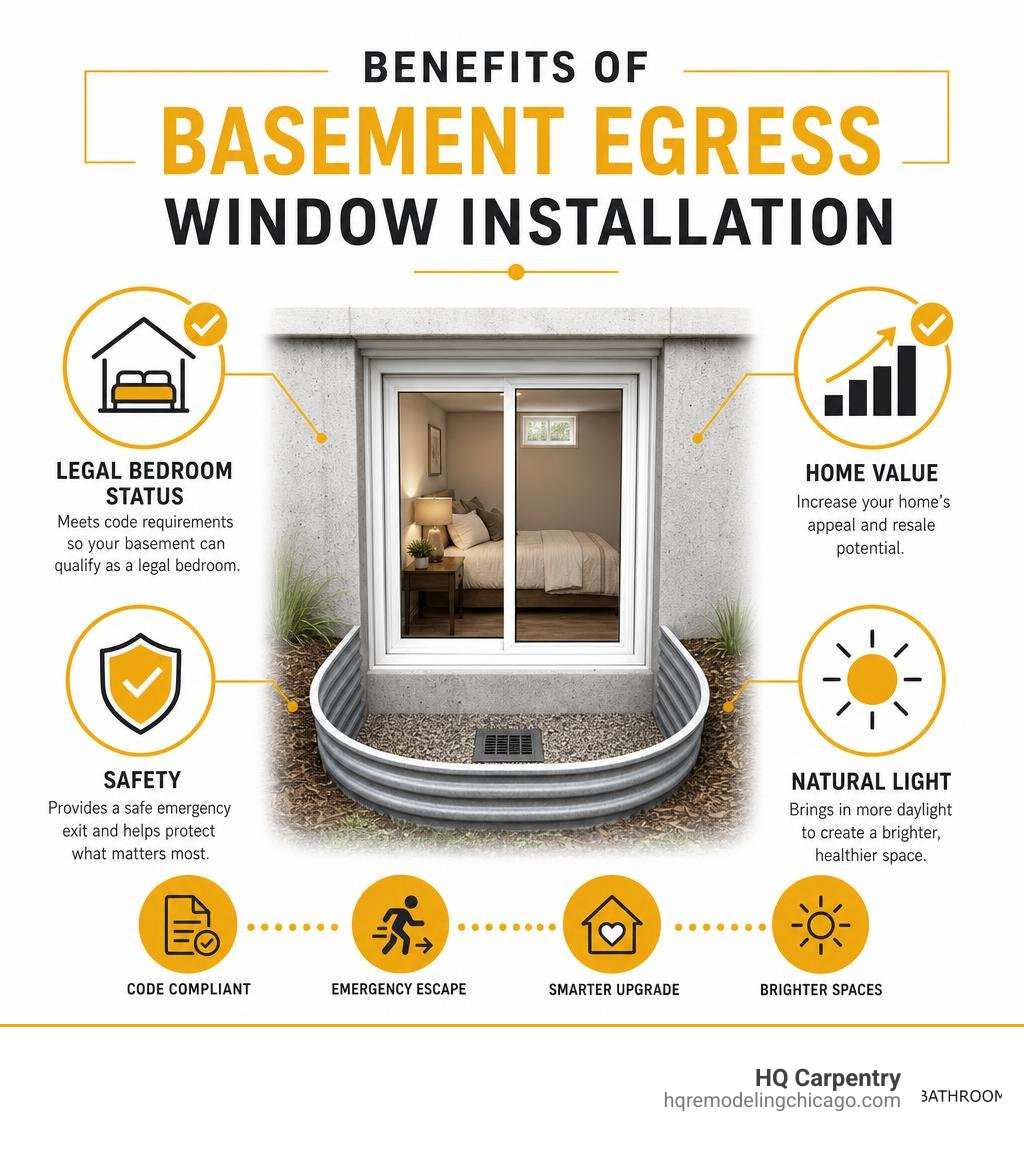
The result? A basement room that is legally a bedroom, flooded with natural light, and worth significantly more at resale.
For Chicago bungalow owners and North Shore homeowners alike, this single upgrade can unlock thousands in appraised value — all while bringing your home up to current safety code. But it’s also a project where the wrong approach creates real problems: water intrusion, failed inspections, and structural damage that costs far more to fix than the original job.
This guide walks you through exactly how to do it right — with no unnecessary mess, no code surprises, and no costly mistakes.
The Structural Essentials of Basement Egress Window Installation
Modifying a foundation wall is not like hanging a picture frame. It requires a precise understanding of structural loads, soil pressure, and local building regulations. When we perform a Basement Remodeling Chicago project, ensuring safety and compliance is our absolute priority.
Every municipality from Oak Park to Wilmette enforces strict rules regarding emergency escape and rescue openings (EEROs). These rules are designed with one primary goal in mind: ensuring that in the event of an emergency, a sleeping resident can easily escape, and a fully equipped firefighter can easily enter.
IRC Code and Sizing Requirements
The International Residential Code (IRC) Section R310 establishes the baseline standards for all basement egress windows. To be legally compliant, the window must meet the following four critical dimensional standards:
- Minimum Net Clear Opening Area: The actual open space when the window is fully opened must be at least 5.7 square feet (or 5.0 square feet if the window is at grade level). This refers to the clear open space, not the total window frame size.
- Minimum Net Clear Opening Height: The opening must be at least 24 inches high.
- Minimum Net Clear Opening Width: The opening must be at least 20 inches wide.
- Maximum Sill Height: The bottom of the clear opening (the sill) must not be more than 44 inches from the finished basement floor.
If your window sill is higher than 44 inches, building codes require a permanently fixed step or ladder to bridge the gap. When planning your layout, it is highly beneficial to study detailed resources like the guide on How to Install an Egress Window to understand how these dimensions translate to structural modifications.
Window Well, Cover, and Ladder Specifications
When the window sill sits below the exterior ground level—which is almost always the case in deep Chicago basements—a window well is required. The well itself must meet specific dimensions to allow a clean exit:
- Clear Area: The well must provide a horizontal area of at least 9 square feet.
- Projection: It must project at least 36 inches outward from the foundation wall.
- Width: The well width must be at least 36 inches and run parallel to the fully opened window.
- Ladders and Steps: If the window well depth exceeds 44 inches, a permanently attached ladder or steps must be installed. The ladder must not project more than 6 inches into the required clear area.
Additionally, any protective grates or covers placed over the well must be easily openable from the inside without the use of keys, tools, or special knowledge. For homeowners in Elmhurst or Glenview, matching these wells with custom safety covers is crucial for keeping out debris, snow, and pests while maintaining absolute safety. You can learn more about local options through Elmhurst, IL Window Well Covers and Replacement.
Step-by-Step Guide to a Mess-Free Installation
Cutting through concrete foundation walls inherently creates dust, water, and debris. However, with professional planning, specialized equipment, and a systematic approach, we can keep the interior of your home completely spotless.
When executing a high-quality Home Remodeling Chicago project, we treat your living space with the utmost respect. Our mess-free protocol involves sealing off the work zone inside the basement with heavy plastic sheeting, setting up commercial HEPA air scrubbers, and performing all concrete cutting from the exterior of the home.

Excavation and Utility Marking
Before any shovel touches the dirt, we must locate and mark all underground utilities.
- Call 811: We contact the local utility locating service at least 48 hours before digging. This is a mandatory step in Illinois to prevent hitting gas, electric, water, or fiber-optic lines.
- Protect the Lawn: We lay down heavy plywood sheets across your lawn to protect the turf from wheelbarrows and compact excavation equipment.
- Excavate the Well: We hand-dig or use a compact mini-excavator to dig a hole that is roughly 12 inches wider than the planned window well on all sides. This extra space is essential for proper drainage installation and backfilling. For a detailed breakdown of site preparation, refer to the Egress Window Installation: Step-by-Step Process Guide.
Precision Concrete Cutting and Foundation Prep
Once the exterior soil is cleared and the foundation wall is exposed, we prepare for the cut.
- Interior Containment: We build a floor-to-ceiling plastic dust barrier around the interior window location and seal the edges with painter’s tape.
- Precision Scoring and Cutting: We use a high-powered, diamond-blade saw equipped with water-suppression attachments. By cutting entirely from the outside, we prevent concrete dust from spreading throughout your home.
- Removing the Concrete Block: The concrete slab is cut into manageable blocks, which are carefully pried outward into the excavated hole, keeping the interior basement floor dry and clean.
- Buck Frame Replacement: We remove any old, rotting wood frames and replace them with rot-proof vinyl or pressure-treated structural bucks, securing them with heavy-duty concrete anchors and high-grade polyurethane sealants.
Window and Well Integration
With the rough opening prepared, we install the window and the exterior well system.
- Setting the Window: We position the new egress window, ensuring it is perfectly plumb, level, and square. We apply waterproof flashing tape over the exterior nailing fins and seal all perimeter gaps with low-expansion foam insulation.
- Installing the Drainage System: We dig down to your home’s existing footing drain (weeping tile) and connect a 4-inch perforated drain pipe. We fill the bottom of the well with 6 to 12 inches of washed gravel to ensure water drains away rapidly during heavy Midwest downpours.
- Securing the Well: We bolt the prefabricated window well directly to the foundation wall using heavy-duty anchors, applying a thick bead of waterproof sealant along the vertical seams. If you are considering a specialized kit, the Easy Egress Kit for Windows | Dual Action Egress System is an excellent option that combines durable well structures with compliant window systems.
Key Factors Affecting Installation Complexity
No two basement egress installations are identical. The age of your home, the composition of your foundation, and the local water table all play major roles in determining how the project is executed.
Foundation Type: Poured Concrete vs. Concrete Block
The structural material of your foundation dictates the tools and labor required to create the opening:
- Poured Concrete Foundations: Common in newer North Shore homes, these walls are exceptionally strong and dense. Cutting through 8 to 10 inches of solid poured concrete requires heavy-duty diamond-blade hydraulic saws. This process is highly precise but requires specialized operator skills to ensure the structural integrity of the wall is maintained.
- Concrete Block Foundations: Frequently found in older Chicago bungalows and homes built prior to the 1970s. While block walls can sometimes be dismantled block-by-block, they require careful temporary shoring and structural reinforcement (such as installing a steel lintel or header above the opening) to prevent the surrounding blocks from shifting or collapsing.
Choosing the Best Window Type for Basement Egress Window Installation
Selecting the right window style is about balancing code compliance, ease of operation, and energy efficiency:
- Casement Windows (Crank-Out): These are the clear winners for basement egress. Because the sash swings completely outward like a door, they provide the maximum clear opening area with the smallest overall frame footprint. They easily meet the 5.7 square foot requirement.
- Sliding Windows: To meet egress code with a sliding window, the overall frame must be twice as large because only half of the window opens at any given time. This requires a much larger cut in your foundation wall.
- In-Swing Hopper Windows: These open inward into the basement room. They are ideal for tight spaces where an outward-swinging window might hit the well wall, but they require at least 30 inches of unobstructed interior floor space to open fully.
- Vinyl Frames and Low-E Glass: We always recommend vinyl frames for basement applications because they do not rot, rust, or warp under moisture pressure. Combining vinyl with double-paned Low-E glass ensures excellent thermal insulation, helping to prevent drafts and reduce energy loss.
Maximizing Home Value and Safety
Adding a code-compliant egress window is one of the very few home improvement projects that can boast an immediate, substantial return on investment.
In the eyes of real estate appraisers and buyers, a basement room without an egress window is simply “storage space” or a “recreation room.” The moment you complete a professional basement egress window installation, that space legally becomes a bedroom. This simple distinction can add significant appraised value to your home, often returning several times the initial cost of installation at resale.
| Feature | Legal Basement Bedroom (With Egress) | Non-Compliant Basement Space |
|---|---|---|
| Resale Classification | Official Bedroom (Increases home count) | Recreation / Storage Room |
| Emergency Escape Route | Compliant direct exit to exterior | Stairs to main floor only |
| Natural Light & Air | High (Meets 8% glass-to-floor ratio) | Low (Dark and poorly ventilated) |
| Appraisal Value Impact | Adds significant appraised value | Minimal impact on home value |
| Liability Risk | Low (Fully permitted and safe) | High (Safety hazard for sleeping occupants) |
Why Professional Basement Egress Window Installation Beats DIY
While some advanced home improvement projects can be tackled over a weekend, egress window installation should never be a DIY endeavor. The structural risks are simply too high.
- Structural Failures: Cutting a large hole in a load-bearing foundation wall without proper temporary supports can cause structural settling, wall cracking, or even localized collapse.
- Water Intrusion: A poorly sealed window or an incorrectly designed drainage system will turn your window well into a swimming pool, leading to catastrophic basement flooding during heavy rain.
- Permit and Code Rejections: If your measurements are off by even half an inch, the local building inspector will fail the project, requiring costly reconstruction.
- Professional Liability: When you hire a fully licensed and insured contractor like us, we assume all structural liability, pull the necessary permits, and guarantee the work passes local inspections. To learn more about standard industry practices and expectations, you can consult the Egress Window Cost 2026: Basement Installation & Replacement Prices | The Basement Guide.
Permits, Inspections, and Retroactive Compliance
In Chicago and surrounding suburbs like Skokie, Evanston, and Winnetka, obtaining a building permit is mandatory for any foundation modification.
The permitting process typically involves submitting a detailed site plan, window manufacturer specification sheets, and structural drawings. During the project, local building inspectors will perform two key inspections:
- The Rough Inspection: Completed after the concrete is cut and the structural header is installed, but before the window is trimmed and backfilled.
- The Final Inspection: Completed after the window, well, ladder, and drainage systems are fully finished to verify code compliance.
If you previously finished a basement bedroom without pulling permits or installing an egress window, you face significant liability risks. If you decide to sell the home, a buyer’s inspector will quickly flag the non-compliant bedroom, giving the buyer massive negotiating leverage or halting the sale entirely. We specialize in retroactive compliance, helping homeowners pull retroactive permits and install code-compliant systems to secure their home’s legal status.
Frequently Asked Questions About Egress Windows
How long does the installation process take?
For a standard project, the entire installation process takes 1 to 3 days.
- Day 1: We protect the site, complete the excavation, and perform the precision concrete cutting.
- Day 2: We install the window buck, set the window, secure the exterior well, and establish the drainage field.
- Day 3: We complete any necessary interior trim work, backfill the exterior well, and clean the site in preparation for final inspection.
How does egress installation affect basement waterproofing?
When installed correctly, an egress window actually improves your basement’s water resistance. By connecting the window well’s gravel drainage field directly to your home’s foundation drain tiles, heavy rainwater is routed safely away from your walls.
Adding a high-quality, sloped polycarbonate cover also prevents rain, melting snow, and yard runoff from pooling inside the well. For residents in Glenview and surrounding suburbs, professional well maintenance and covers are essential safeguards—details of which can be found at Glenview, IL Window Well Covers and Replacement.
Are there energy-efficiency tax credits available in 2026?
Yes! Under current federal guidelines, installing energy-efficient windows can qualify you for the Energy Efficient Home Improvement Credit. By choosing a vinyl-framed egress window with a certified low U-factor and Low-E glass, you may be eligible for a federal tax credit of up to $600. We can help you select qualifying window units and provide the necessary documentation for your tax records.
Secure Your Home’s Safety and Value with HQ Carpentry
Adding a basement egress window is one of the most impactful investments you can make in your home. It protects your family, floods your basement with beautiful natural light, and officially turns underutilized space into a legal, value-adding bedroom.
At HQ Carpentry, we bring over 15 years of hands-on remodeling experience to every project. Founded by Tomasz Pietrzyk, we are fully licensed, insured, and proud to maintain a 5.0 Google Reviews rating. We handle the entire process from start to finish—including building permit acquisition, structural adjustments, and flawless basement finishing. Whether you live in Lincoln Park, Skokie, Glencoe, or Oak Brook, we treat your home with the care and precision it deserves.
Ready to transform your basement safely and cleanly? Visit hqremodelingchicago.com to schedule your consultation and get a free estimate.
Ready to start your remodel?
Tell us about your project and we'll follow up with next steps.
Free Quote