The Windy City Guide to Legal Basement Egress Windows
Basement Egress Windows Chicago: Why Homeowners Can’t Afford to Ignore Them
If you’re researching basement egress windows in Chicago, here’s the short answer:
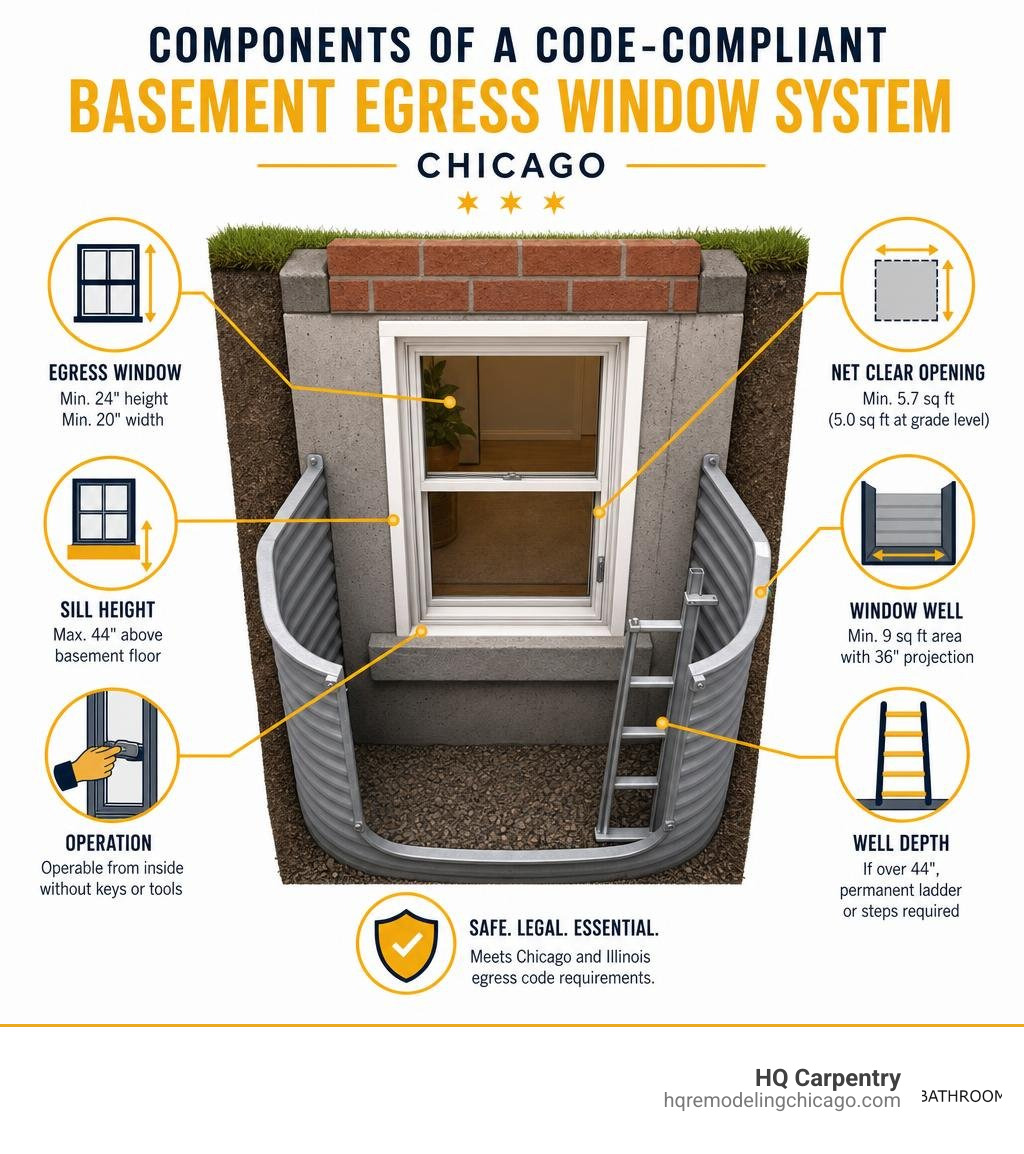
Chicago and Illinois code requires at least one egress window in every basement sleeping room. It must meet these minimum standards:
| Requirement | Minimum Standard |
|---|---|
| Net clear opening | 5.7 sq ft (5.0 sq ft at grade level) |
| Clear opening height | 24 inches |
| Clear opening width | 20 inches |
| Maximum sill height | 44 inches above floor |
| Window well area | 9 sq ft with 36-inch projection |
| Well depth over 44 inches | Permanent ladder or steps required |
| Operation | From inside, no keys or tools needed |
Many Chicago homes — especially the classic brick bungalows you’ll find in neighborhoods like Lincoln Park, Avondale, and across the North Shore — were built long before modern egress codes existed. Their basement windows are typically small, single-pane, and fixed in place. They let in almost no light, they don’t open properly, and in an emergency, no one is getting out through them.
That’s a real problem — both for safety and for how your basement can legally be used.
If you want to finish your basement, add a bedroom, or simply bring your home up to code, a proper egress window installation is the starting point. And in Chicago, that means concrete cutting, excavation, permits, and professional installation — not a simple swap at the hardware store.
HQ Carpentry has been helping Chicago and North Shore homeowners navigate this process since 2011. This guide covers everything you need to know, from code requirements to the installation process and long-term maintenance.
Understanding Code Requirements for Basement Egress Windows Chicago
Navigating the building codes in Chicagoland can feel like trying to drive down Lake Shore Drive during a winter blizzard. However, understanding the Illinois Residential Code (IRC) is non-negotiable when planning your basement project. These rules are designed with one primary goal in mind: ensuring that your family and guests have a secondary means of escape during an emergency, such as a fast-spreading house fire.
When you upgrade your basement, you cannot simply rely on standard utility windows. These old fixtures are often rusted shut, painted over, or simply too narrow to act as a realistic escape path. Working with a professional team ensures your new installations meet every strict guideline set by state and local authorities.
Before selecting your materials, it is helpful to look at different Basement Window Options to see how modern products balance safety with thermal performance. Integrating these installations into your broader basement finishing services ensures that the layout remains open, legal, and completely compliant with local building departments.
Sizing Specifications for Basement Egress Windows Chicago
To be legally classified as an emergency escape and rescue opening, your new window must meet strict dimensional minimums. First, the window must provide a minimum net clear opening of 5.7 square feet. This represents the actual clear space created when the window is fully opened, not the overall size of the window frame itself. If the opening is located at grade level, this requirement is slightly reduced to 5.0 square feet.
Second, the physical dimensions of the opening must allow an adult first responder carrying equipment to pass through easily. This means the clear opening height must be at least 24 inches, and the clear opening width must be at least 20 inches. You cannot simply multiply a 20-inch width by a 24-inch height to meet the square footage requirement, as that would only yield 3.33 square feet. The window must be large enough in both directions to meet that 5.7 square foot threshold.
Finally, the sill height of the window must not exceed 44 inches above the finished basement floor. If your existing window opening is located higher up on the foundation wall, we must carefully cut the concrete downward to lower the sill to a safe, reachable level.
Window Well and Ladder Requirements
Because most Chicago basements are fully or partially below grade, your new egress window will require a structural window well on the exterior of your home. The window well must provide a minimum of 9 square feet of floor area, with a horizontal projection and width of at least 36 inches. This ensures there is plenty of room for an occupant to climb out and for a firefighter in full gear to climb in.
If the window well is deeper than 44 inches, building codes require a permanently attached ladder or steps. The ladder must not encroach more than 6 inches into the required 36-inch projection of the well. Additionally, the rungs of the ladder must be spaced no more than 18 inches apart vertically and must be at least 12 inches wide.
To keep leaves, debris, and curious neighborhood critters out of your deep well, you should consider specialized Glenview Window Well Cover Solutions. These covers protect the well from blocking your exit path while still being easily openable from the inside without the use of keys, tools, or special physical effort.
When is a Basement Egress Window Legally Required?
We often hear from homeowners in Skokie, Evanston, and Arlington Heights who ask if they really need to go through the hassle of installing a large egress window. The answer depends entirely on how you intend to use your lower-level space. If your basement is strictly used for housing your furnace, water heater, and holiday storage bins, standard hopper windows are perfectly fine.
However, the moment you decide to turn that dark, underutilized space into a habitable living area, the rules change completely. The city of Chicago and surrounding suburbs require a reliable emergency exit path for any finished room where people spend significant time.
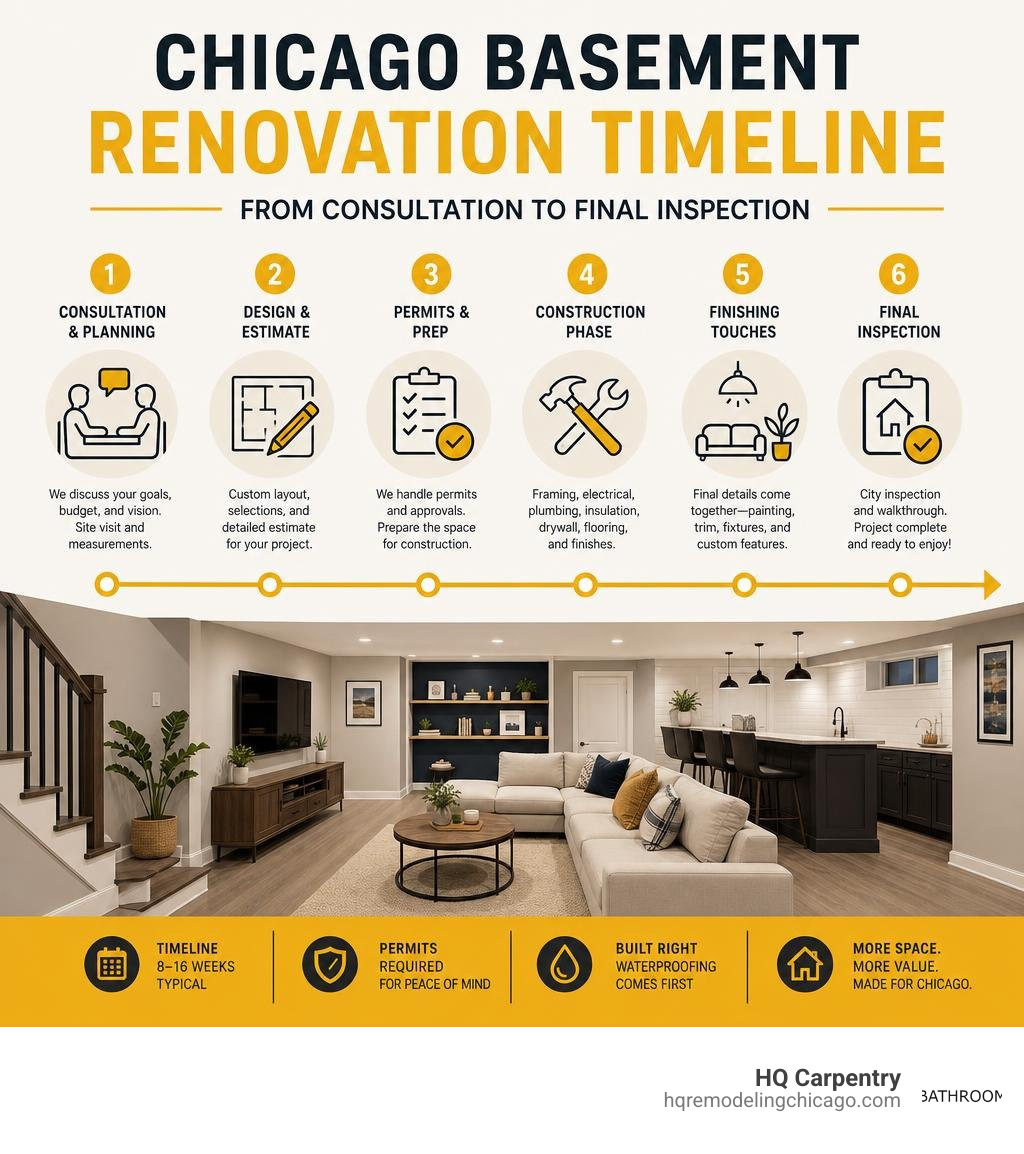
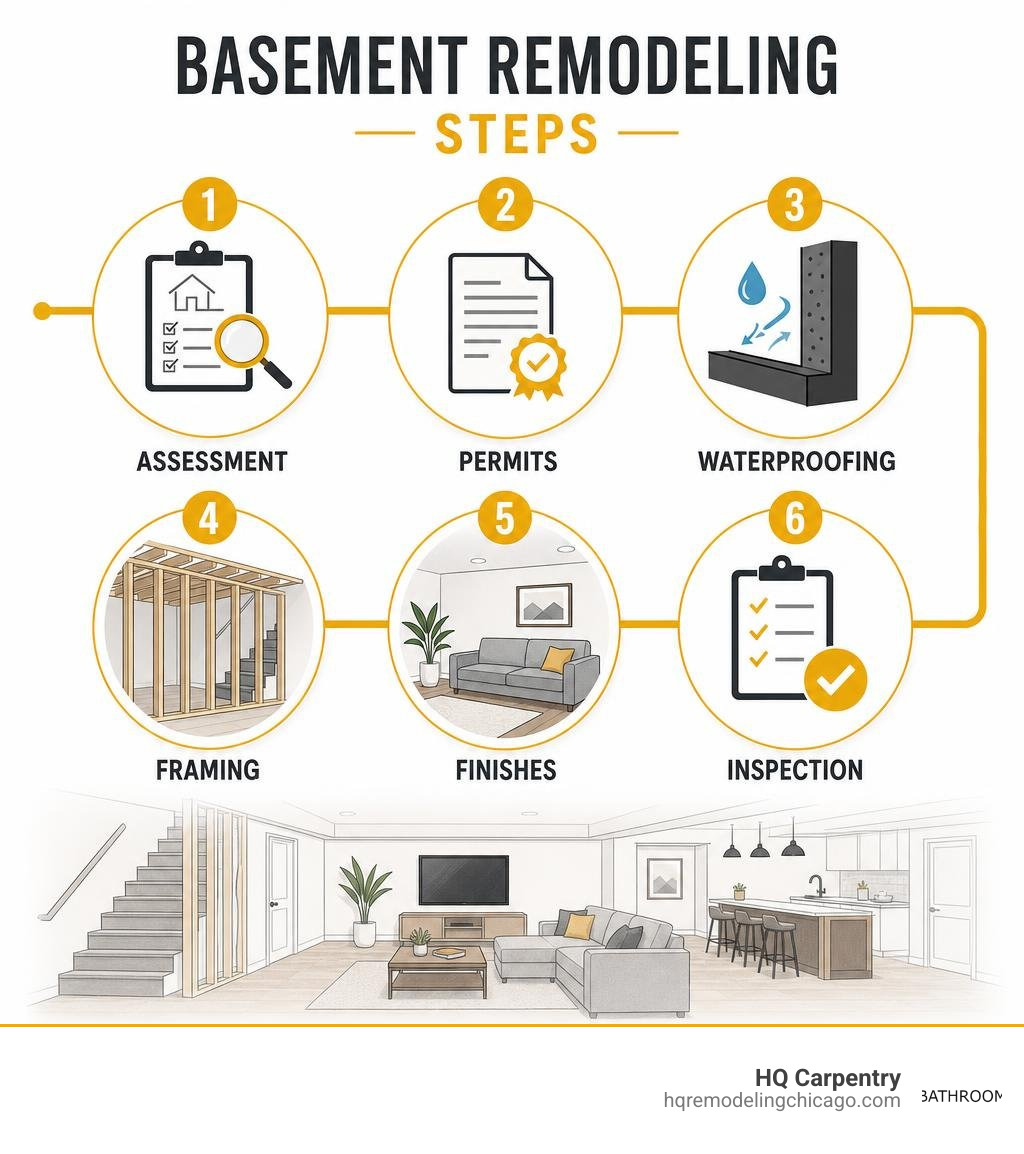
If you are currently in the design phase of your renovation, early basement renovation planning is critical. Incorporating the necessary concrete cutting and window framing into your initial plans prevents costly layout changes later on when building inspectors come to sign off on your permits.
Converting Basements to Bedrooms
If you plan to add a bedroom to your basement, you must install a code-compliant egress window in that specific room. It does not matter if there is already an egress window in the main recreation room down the hall. If a door can be closed to isolate a sleeping space, that room must have its own direct, dedicated exit to the outdoors.
To be legally classified as a bedroom on a real estate appraisal in Illinois, the room must have a closet, a minimum ceiling height, and a secondary means of egress. Without a certified egress window, you cannot legally market your home as having an extra bedroom when it comes time to sell. More importantly, sleeping in a basement bedroom without a clear exit path is an extreme safety hazard that we never recommend.
Upgrading Existing Unfinished Spaces
Even if you aren’t adding a dedicated bedroom, transforming your unfinished basement into a home office, a family theater, or a playroom for the kids usually triggers the need for an egress window. Most local municipal codes require at least one emergency exit in any finished basement living area, regardless of whether it is used for sleeping.
Adding a large, high-quality window during your home remodeling Chicago project does more than just satisfy the local building inspector. It completely changes the atmosphere of your lower level. It floods the space with natural light, provides excellent fresh air ventilation, and eliminates that damp, subterranean “cave” feeling that so many older Chicago homes suffer from.
Selecting the Right Window Styles and Well Drainage
Choosing the right window style is about balancing ease of operation, energy efficiency, and structural constraints. Because basement walls are under constant pressure from the surrounding soil, your window frames must be incredibly strong and moisture-resistant.
Let’s look at how the two most common styles compare for basement egress installations:
| Window Style | Egress Compliance | Energy Efficiency | Ventilation & Light |
|---|---|---|---|
| Casement Windows | Excellent. The sash swings outward like a door, maximizing the clear opening. | High. Compression seals block drafts and moisture effectively. | Great airflow control and maximum glass area for natural light. |
| Sliding Windows | Good, but requires a much wider rough opening because only half the window opens at a time. | Moderate. Brush seals can wear out over time in damp environments. | Easy to operate but provides less overall glass area for light. |
While sliding windows are highly popular for upper levels, we often recommend out-swinging casement windows or specialized in-swinging side-hinge windows for basement projects. These styles allow us to meet the strict 5.7 square foot net clear opening requirement using a much smaller overall structural footprint in your foundation wall.
Maximizing Natural Light and Ventilation
Modern egress windows are designed to be highly energy-efficient. We utilize reinforced uPVC frames that will not rust, rot, or warp when exposed to the damp environment of a below-grade window well. Unlike old steel-framed utility windows, modern vinyl frames provide a complete thermal break that keeps the cold Chicago winter air outside.
For maximum comfort, we recommend double-pane or triple-pane insulated glass units treated with Low-E (low-emissivity) coatings. This specialized glass reflects heat back into your home during the winter and blocks harsh UV rays during the summer, keeping your finished basement at a comfortable, consistent temperature all year round.
Preventing Basement Flooding and Water Leaks
In Chicagoland, the soil is heavily packed with clay. This means rainwater does not drain away quickly; instead, it pools against your foundation. Ground water is naturally attracted to excavated window well areas, making proper drainage coordination absolutely essential to prevent basement flooding.
When we install a new egress window system, we dig the well deep enough to install a dedicated drain that connects directly to your home’s perimeter drain tile system or routes to a sump pump. We line the bottom of the well with a thick, clean layer of washed gravel to facilitate rapid water flow. This ensures that even during a heavy Midwestern downpour, water is instantly channeled away from your window frame and foundation wall.
The Professional Installation Process in Chicagoland
Installing basement egress windows in Chicago is not a weekend DIY project. It is a complex structural modification that involves heavy excavation, precision concrete cutting, and proper load-bearing support.
At HQ Carpentry, our fully licensed and insured team handles every step of this process with meticulous care. Whether we are working on a classic brick home in Oak Park or a modern property in Wilmette, we follow a proven installation sequence to protect your home’s structural integrity.
Excavation and Foundation Cutting
Our process begins with careful planning and site preparation. Before a single shovel touches the dirt, we coordinate building permit acquisition and call 811 to have all underground utility lines clearly marked. This is crucial for protecting gas, water, and electrical lines running through your yard.
To protect your landscaping and turf, we often perform the excavation by hand. Once the exterior pit is dug, we use a specialized, high-powered hydraulic concrete saw to cut through your thick foundation wall. This tool allows us to make clean, straight cuts through concrete, stone, or brick without causing structural vibrations that could damage your upper-level plaster or drywall.
Framing, Window Fitting, and Backfilling
After the concrete section is carefully removed, we install a heavy-duty structural header or lintel if required by your home’s layout. We then construct a pressure-treated timber buck or frame inside the raw concrete opening. This frame is securely anchored to the foundation and sealed with professional-grade polyurethane sealants to create an airtight, watertight barrier.
Next, we set and level the new window unit, anchoring it firmly to the wood buck. We install the structural window well on the exterior, securing it directly to your foundation wall. Finally, we backfill the surrounding excavation area with gravel and compacted soil, grading the surface away from your home to ensure proper water runoff.
Frequently Asked Questions About Egress Installation
Can I modify an existing basement window to meet egress codes?
Yes, in almost all cases, we modify an existing basement window opening rather than starting completely from scratch. Standard basement windows are far too small to meet egress codes, so we must expand the rough opening. This involves cutting the concrete foundation downward and sometimes outward to accommodate the larger, code-compliant window frame and well system.
How do egress windows affect my home’s property value?
Installing an egress window is one of the highest-ROI upgrades you can make to your home. By adding a legal egress window, you can officially count your finished basement space as a legal bedroom on real estate listings. Converting a 3-bedroom home into a legal 4-bedroom home significantly increases your appraisal value, expands your pool of potential buyers, and ensures your home stands out in competitive suburban markets like Glenview, Northbrook, and Park Ridge.
How Do I Maintain Basement Egress Windows Chicago?
Maintaining your egress window system is simple but essential for long-term performance:
- Clear Debris: Regularly remove fallen leaves, twigs, and windblown trash from the bottom of the window well.
- Check the Drain: Ensure the gravel base remains clean and that the drain opening is not blocked by dirt or silt.
- Inspect Seals: Once a year, check the caulking and weatherstripping around the window frame for any signs of wear.
- Lubricate Hinges: Keep the window hinges and latching mechanisms lubricated so the window opens smoothly and easily in an emergency.
Partner with Chicagoland’s Trusted Egress Specialists
Adding a basement egress window is a major home improvement project that requires experienced hands. Since 2011, HQ Carpentry has provided reliable, code-compliant structural remodeling and basement finishing services across Chicago and the surrounding North Shore suburbs.
Founded by Tomasz Pietrzyk, who brings over 15 years of hands-on construction experience, our company is fully licensed, insured, and holds a perfect 5.0 Google Reviews rating. We never cut corners, we manage the entire building permit acquisition process for you, and we treat your home with the utmost respect.
Whether you are located in Niles, Skokie, Evanston, Glencoe, Winnetka, or right in the heart of Chicago, we are ready to help you make your basement safer, brighter, and legally compliant.
Contact us today for a free estimate at (773) 968-3606 or visit hqremodelingchicago.com to schedule your consultation!
Ready to start your remodel?
Tell us about your project and we'll follow up with next steps.
Free Quote