How a Curved Oak Handrail Is Made (and When You Need One)
A curved oak handrail is made by gluing thin strips of oak around a form cut to the shape of your stair. Once the glue cures, the curve is shaped, sanded and mounted on the wall. You need one when your stair turns or curves and a straight rail would leave gaps, joints and awkward angles. This guide explains how the process works, where bent rails fit and what to plan before you order one.
What Is a Bent Handrail?
A bent handrail is a rail with the curve built into the wood. It is not cut out of a wide board, and it is not a set of straight pieces joined at angles. It is a shaped piece that follows the line of the stair, so your hand can move through a turn without a stop.
You may hear it called a curved handrail or a laminated handrail. The word laminated describes how it is made: many thin layers bonded into one solid piece. Most stair rails in Chicago-area homes are straight, because most stairs are straight. A bent rail is a custom item, built for one stair.
When Do You Need a Curved Handrail?
The simple answer: when the stair or its wall is not straight. A straight rail can only follow a straight run. If the stair changes direction, something has to give, and with a straight rail what gives is the fit.
- Turning stairs. Quarter-turn and half-turn stairs change direction at a landing or through winding steps.
- Curved stair walls. When the wall itself bends, a wall-mounted rail has to bend with it.
- S-curves. The wall curves one way and then the other, and the rail follows both curves.
- Landings that wrap a corner. A rail that turns at the landing without a break feels safer in the hand.
- New builds and remodels. New homes can plan the rail along with the stair. In a remodel, an old rail that no longer fits is replaced with one that does.
In our bent oak handrails project, the rails follow a stair through its turns and curves while staying mounted on the wall. You can see the stair, the turn and the landing in the photos.
How Is a Curved Oak Handrail Made?
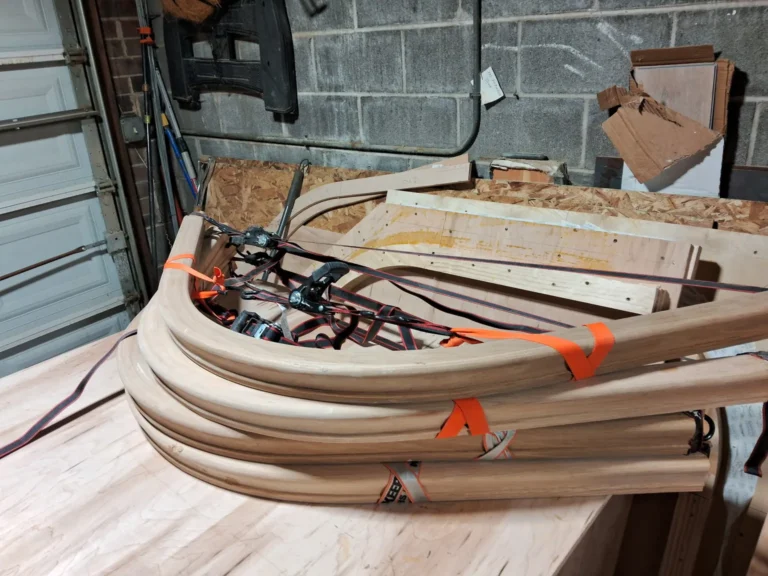
The method is called laminated bending. A thick piece of oak does not bend into a tight curve by itself. A thin strip does. So instead of bending one thick piece, we bend many thin strips at once and glue them together. When the glue cures, the strips hold the curve as one solid piece.
Step 1: Cut the form
Everything starts with a form. We cut a plywood form to the radius of your stair, so the finished curve matches the wall. A good form is the most important part of the job. If the form is off, the rail will be off, and it will not sit right against the wall.
Step 2: Glue and clamp the strips
Next, we glue the oak strips together and clamp them around the form. Clamps go along the whole length of the curve, so the pressure is even and the layers pull tight against each other. A long curve needs a lot of clamps. This is the step that gives the rail its shape, and it has to be done before the glue starts to set.
Step 3: Let the glue cure
The glued strips stay on the form until the glue has cured. Taking the piece off too early can let the curve relax. Waiting is part of the job, and we plan for it in the schedule.
Step 4: Shape and sand
After the glue cures, the piece comes off the form as a rough curve. We shape it into a handrail, with a profile that feels natural in the hand, and sand it smooth. Sanding matters more on a handrail than on most woodwork, because your hand touches every inch of it.
Step 5: Fit and mount
Finished curved sections are fitted on the stair one after another. On a stair with several turns, the sections come together as one rail. The rail is then mounted on wall brackets. In our project, we used black round brackets and ended the rail with a return, which turns the end back toward the wall. See the curved and bent handrails page for how we build and install them.
Why Oak?
Oak is a strong hardwood with a clear grain. It is common in stair work because it holds up to daily hand contact and takes stain and clear finish well. Many Chicago homes already have oak floors or oak trim, so an oak rail can match what is there.
Oak also suits laminated bending, because thin oak strips follow a form well. Another wood may be a better match in some homes, so ask about it at the planning stage. Whatever the wood, the finish should match the rest of the stair.
What to Plan Before You Order a Bent Rail
A bent rail is made to fit, so the planning comes before the building. These are the points to settle first.
- The shape of the stair. The radius of the turn and the line of the wall decide the form.
- Where the rail starts and ends. Decide whether it ends with a return to the wall.
- How it will be mounted. Wall brackets need solid backing behind the wall, so check what is behind the surface.
- The finish. Stain, clear coat or a paint-ready rail. Match it to the floors, the trim and the stair parts around it.
- The timing. In a new build or remodel, plan the rail with the stair, before the wall is finished.
Building code and the inspector
A handrail is a safety part of the stair, so it has to meet your local building code. The rules come from the city or village where you live. In Chicago, that is the City of Chicago Department of Buildings. Each suburb has its own building department. We follow the inspector’s requirements, and we check what applies to your home before we build. If your project is part of a larger remodel, our general contracting team can manage the stair and the rail together.
Should You Make One Yourself?
Laminated bending is a skilled job. It needs an accurate form, enough clamps, glue that is applied in time and a clean way to shape the cured piece. A small mistake in the form shows up in the finished curve. Because the rail is a safety item, a poor result is more than a look problem. For most homeowners, a carpenter who builds custom rails is the better route. If you are curious about the process, the photos in our project show each stage, from the glue-up to the finished rail on the stair.
Frequently Asked Questions
Can a curved oak handrail match an existing stair?
Yes. The form is cut to the radius of your stair, so the rail follows the stair and the wall. We take the measurements at a free in-home visit and plan the rail with you. If the stair has several turns, the rail is made in sections and fitted together on the wall.
What is the difference between a bent rail and a rail made from straight pieces?
A rail made from straight pieces has joints and angles where the stair turns. A bent rail has the curve in the wood, so it follows the turn in one smooth line. It also feels better in the hand, because there is no corner to catch on.
Can the rail be stained or painted?
Oak takes stain and clear finish well. The right choice depends on the floors, trim and stair parts around it. Talk through the finish at the planning stage, so the rail matches the rest of the stair.
Does a new handrail need a permit?
It depends on where you live and on the rest of the project. Rules are set by the City of Chicago or your suburb’s building department. We check what applies to your home and follow the inspector’s requirements for the rail.
Have a Curved Stair?
HQ Carpentry builds custom bent oak handrails for curved and turning stairs in Chicago and the suburbs. We are licensed and insured. Request a free estimate or call (773) 968-3606. We come to your home, look at the stair and give you a fixed written quote after the visit. The work comes with our 1-year workmanship warranty.
Ready to start your remodel?
Tell us about your project and we'll follow up with next steps.
Free Quote